
August 14, 2026
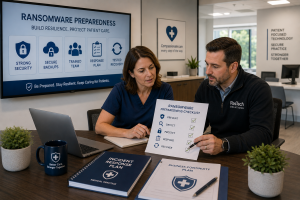 Ransomware remains one of the most disruptive cybersecurity threats facing healthcare organizations today. A successful attack can prevent staff from accessing electronic health records (EHRs), scheduling appointments, processing insurance claims, or communicating with patients, bringing daily operations to a standstill.
While no organization can eliminate every cyber risk, healthcare practices can significantly reduce both the likelihood and impact of a ransomware attack through proper planning, layered security, and well-defined recovery procedures.
This guide outlines a seven-step framework that helps healthcare organizations strengthen their defenses before an attack occurs.
Why Healthcare Practices Are Frequent Targets
Healthcare organizations are attractive targets because they depend on immediate access to patient information and cannot tolerate prolonged downtime.
Cybercriminals often assume medical practices are more likely to pay a ransom if critical systems become unavailable.
Common targets include:
- Electronic Health Record (EHR) systems
- Patient scheduling platforms
- Billing systems
- Microsoft 365 accounts
- File servers
- Backup systems
- Connected medical devices
The goal of ransomware isn't simply to encrypt data. It's to disrupt operations and pressure organizations into making quick decisions.
A 7-Step Readiness Framework
Preparing for ransomware is about creating multiple layers of protection rather than relying on a single security product.
Step 1: Strengthen User Security
Many ransomware attacks begin with a compromised user account.
Reduce this risk by implementing:
- Multi-Factor Authentication (MFA)
- Strong password policies
- Role-based access
- Prompt user offboarding
- Ongoing security awareness training
Educated employees remain one of the most effective security controls.
Step 2: Keep Systems Updated
Attackers frequently exploit known software vulnerabilities.
Healthcare practices should maintain:
- Operating system updates
- Application updates
- Firmware updates
- Network equipment updates
- Automated patch management whenever practical
Keeping systems current closes many common attack paths.
Step 3: Deploy Layered Security
No single security solution can stop every attack.
A layered approach may include:
- Endpoint Detection and Response (EDR)
- Business-grade firewall protection
- Email security
- DNS and web filtering
- Device encryption
- Continuous monitoring
Each layer increases the difficulty for attackers.
Step 4: Protect and Test Your Backups
Backups are one of the most important defenses against ransomware.
An effective backup strategy should include:
- Encrypted backups
- Multiple backup copies
- Off-site or cloud-based storage
- Routine backup testing
- Documented recovery procedures
A backup is only valuable if it can be restored successfully.
Step 5: Develop an Incident Response Plan
Every healthcare practice should know what happens if ransomware is suspected.
Your plan should define:
- Who makes key decisions
- How systems are isolated
- Internal communication procedures
- Vendor contact information
- Regulatory and legal considerations
- Patient communication responsibilities
Planning ahead reduces confusion during a stressful event.
Step 6: Practice Your Recovery Process
Documentation alone isn't enough.
Healthcare organizations should periodically review and practice:
- Backup restoration
- Emergency communication
- Alternate workflows
- Downtime procedures
- System recovery priorities
Practicing your response helps identify weaknesses before a real emergency.
Step 7: Review and Improve Continuously
Cybersecurity is never finished.
Healthcare organizations should regularly:
- Review security policies.
- Update incident response plans.
- Perform HIPAA Security Risk Assessments.
- Evaluate new cybersecurity technologies.
- Review lessons learned from security events.
Continuous improvement strengthens long-term resilience.
Warning Signs That May Indicate a Ransomware Attack
While every incident is different, organizations should investigate unusual activity such as:
- Employees suddenly unable to open files.
- Unexpected file extensions appearing.
- Antivirus or security software becoming disabled.
- Multiple user accounts locking out unexpectedly.
- Unusual network activity.
- Computers running significantly slower than normal.
- Suspicious login notifications.
Early detection can sometimes limit the scope of an attack.
Common Mistakes Healthcare Practices Make
Many organizations increase their risk by:
- Assuming backups never need testing.
- Delaying software updates.
- Allowing shared user accounts.
- Skipping employee cybersecurity training.
- Using weak or reused passwords.
- Waiting until after an incident to develop a response plan.
- Believing ransomware is only a problem for large hospitals.
Small and mid-sized healthcare practices are targeted every day.
Questions to Ask Your IT Provider
If you work with a managed IT provider, consider asking:
How do you help protect us from ransomware?
Understand which security technologies, monitoring services, and response procedures are included in your agreement.
How often are our backups tested?
Successful backup testing should be part of an ongoing recovery strategy.
Do we have a documented incident response plan?
Every healthcare organization should understand who is responsible for each step during a cybersecurity event.
How are our systems monitored for suspicious activity?
Continuous monitoring helps identify potential threats earlier.
How often do you review our cybersecurity posture?
Security should be evaluated continuously rather than only after an incident.
Frequently Asked Questions
Can ransomware attacks be prevented completely?
No.
There is no technology that guarantees complete protection. However, layered cybersecurity, employee training, secure backups, and proactive monitoring can significantly reduce both the likelihood and impact of an attack.
Should healthcare organizations pay a ransom?
Every incident is different and involves legal, operational, insurance, and regulatory considerations. Organizations should work closely with legal counsel, law enforcement, cyber insurance providers, and qualified cybersecurity professionals before making any decisions.
Are backups enough to protect us?
Backups are an essential part of ransomware preparedness, but they are only one layer of a comprehensive cybersecurity strategy. Strong identity management, endpoint protection, email security, monitoring, and user training are equally important.
How often should we review our ransomware preparedness?
Healthcare organizations should review their cybersecurity program continuously and revisit incident response plans whenever significant technology or operational changes occur. Many organizations also perform formal reviews annually as part of their broader security planning.
Final Thoughts
Ransomware preparedness isn't about expecting the worst. It's about ensuring your healthcare practice can continue serving patients even when faced with unexpected cybersecurity threats.
By strengthening user security, maintaining current systems, implementing layered defenses, protecting your backups, and practicing your response procedures, your organization can significantly improve its resilience against one of today's most disruptive cyber threats.
The best time to prepare for a ransomware attack is long before one ever occurs.
About ResTech Solutions
ResTech Solutions helps healthcare organizations throughout the Houston area strengthen their cybersecurity through proactive managed IT services, advanced threat protection, Microsoft 365 security, backup and disaster recovery, and long-term technology planning.
Our team works closely with medical practices to build layered cybersecurity strategies that reduce risk, improve operational resilience, and support HIPAA security best practices.
If you'd like to evaluate your organization's ransomware readiness, schedule a no-obligation discovery call with ResTech Solutions. We'll review your current security posture, discuss your recovery capabilities, and help you identify practical opportunities to strengthen your defenses before an incident occurs.