
July 23, 2026
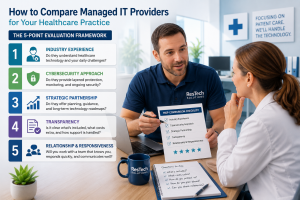 Choosing a managed IT provider is one of the most important business decisions a healthcare practice can make.
The right provider helps improve productivity, strengthen cybersecurity, reduce downtime, and support long-term growth. The wrong provider can leave your practice dealing with recurring technology issues, unexpected invoices, and reactive support.
Unfortunately, many healthcare organizations compare providers based almost entirely on monthly pricing. While cost is certainly important, it tells only part of the story.
A better approach is to evaluate each provider using a consistent framework. By looking beyond price and focusing on the services, experience, and relationship you will receive, you can make a more informed decision.
Why Comparing Managed IT Providers Is Difficult
On the surface, many managed IT providers appear very similar.
Nearly every provider advertises:
- Unlimited support
- Cybersecurity
- Fast response times
- Proactive monitoring
- Experienced technicians
The challenge is that those descriptions rarely explain how services are delivered or what is actually included.
That is why it is important to evaluate providers using more than a feature list.
A Five-Point Framework for Comparing Managed IT Providers
When evaluating managed IT providers, consider these five areas.
1. Industry Experience
Healthcare has unique technology requirements.
Your IT provider should understand how healthcare organizations operate and be familiar with the systems your staff relies on every day.
Ask questions such as:
- Have you worked with medical practices like ours?
- Are you familiar with electronic health record systems?
- How do you help healthcare clients reduce downtime?
- What experience do you have supporting healthcare technology?
Industry experience often leads to faster problem resolution because technicians already understand your environment.
2. Cybersecurity Approach
Every provider says they offer cybersecurity.
The real question is how they approach it.
Look for providers that offer multiple layers of protection, including:
- Endpoint protection
- Security monitoring
- Patch management
- Multi-factor authentication
- Email security
- Security awareness guidance
Cybersecurity should be an ongoing process rather than a single product.
3. Strategic Partnership
A managed IT provider should do more than respond to support requests.
They should also help you make informed technology decisions.
Ask whether they provide:
- Technology planning
- Budget guidance
- Vendor coordination
- Regular business reviews
- Hardware lifecycle planning
- Long-term technology recommendations
A provider that understands your business goals becomes a strategic partner instead of simply a technology vendor.
4. Transparency
A good managed IT agreement should be easy to understand.
You should know:
- What is included
- What is billed separately
- How projects are priced
- How support requests are handled
- Who to contact when you need assistance
Clear expectations help prevent misunderstandings and surprise invoices.
If a proposal seems vague, ask for clarification before signing.
5. Relationship and Responsiveness
Technology is ultimately a people business.
When problems arise, you want to work with professionals who know your environment and understand your practice.
Ask questions like:
- Will we work with the same technicians regularly?
- How are support requests assigned?
- Who serves as our primary point of contact?
- How do you measure client satisfaction?
Strong relationships often lead to better communication, faster issue resolution, and a more positive support experience.
Five Questions Every Healthcare Practice Should Ask
Before selecting a managed IT provider, ask these questions during the evaluation process.
- What is included in your monthly agreement? Request a detailed list rather than relying on marketing materials.
- What services generate additional charges? Understanding exclusions helps you compare proposals fairly.
- How do you approach cybersecurity? Ask about ongoing monitoring, device protection, Microsoft 365 security, identity protection, and employee education.
- How do you help clients plan for future technology needs? Technology planning is just as valuable as technical support.
- Can you provide references from healthcare clients? Speaking with current clients often provides valuable insight into the provider's communication, responsiveness, and overall service quality.
Red Flags to Watch For
As you compare providers, be cautious if you notice any of the following.
- Pricing that seems significantly lower than everyone else without a clear explanation.
- Vague proposals that do not clearly define included services.
- Providers who focus only on fixing problems instead of preventing them.
- No discussion about long-term planning.
- Limited experience supporting healthcare organizations.
- Difficulty getting direct answers during the sales process.
If communication is difficult before you become a client, it is unlikely to improve afterward.
Remember That Value Is Different Than Cost
The least expensive proposal is not always the most affordable over time.
A provider that helps prevent downtime, improve security, and plan technology investments can often reduce the total cost of IT over the life of the relationship.
When comparing proposals, ask yourself:
- Which provider understands our business?
- Which provider appears proactive instead of reactive?
- Which provider communicates clearly?
- Which provider gives us confidence?
Those answers often matter more than the monthly price alone.
Frequently Asked Questions
Should I choose a local managed IT provider?
It depends on your organization's needs.
Many issues can be resolved remotely, but having access to onsite support when needed can still be valuable for healthcare organizations.
Is experience in healthcare important?
Yes.
Healthcare technology environments have unique workflows, security considerations, and operational requirements that differ from many other industries.
Should every managed IT agreement include cybersecurity?
Yes.
Core cybersecurity services should be part of every modern managed IT agreement, although advanced compliance services may be offered separately.
How long should a managed IT agreement last?
Contract terms vary, but many organizations choose multi-year agreements to provide stability while reviewing performance regularly throughout the relationship.
Final Thoughts
Choosing a managed IT provider is about much more than comparing prices.
The right partner should understand your business, communicate clearly, provide strategic guidance, and help your healthcare practice build a secure and reliable technology environment.
Taking the time to evaluate providers using a consistent framework can help you make a confident decision that supports your organization for years to come.
About ResTech Solutions
ResTech Solutions provides managed IT services, cybersecurity, cloud solutions, and strategic technology planning for healthcare organizations throughout the Houston area.
We believe successful IT partnerships are built on trust, transparency, and long-term relationships. Our goal is to help healthcare practices make informed technology decisions through proactive support, predictable pricing, and personalized service.
If you're evaluating managed IT providers and would like an objective conversation about your technology environment, schedule a no-obligation discovery call with ResTech Solutions. We'll answer your questions, review your current approach, and help you determine the best path forward for your practice.